Digitalization & Circular Economy Transfer Hub: Strengthening knowledge transfer between science and business
Offices and workshops of the Hochschule Ruhr West are located on the former site of the Prosper-Haniel colliery in Bottrop, on the premises of the Prosper III start-up center. Alongside the Prosperkolleg e.V., it is a project partner of the Digitalization & Circular Economy Transfer Hub. Transformation is literally taking place here - away from an economy based on fossil raw materials and towards sustainable concepts of circular value creation. The aim of the transfer hub is to develop the digital circular economy as a business area. Its services are aimed at small and medium-sized enterprises (SMEs) in the northern Ruhr region, including the cities of Bottrop, Gladbeck, Dorsten and Marl, as the region is in the midst of structural change. The focus is also on the skilled trades. Around 3,300 full-time jobs that were directly or indirectly related to the use of hard coal are affected by the final phase-out of hard coal in the northern Ruhr region. The circular economy offers a perspective that can awaken new potential: Knowledge and technology transfer should create new opportunities - and new jobs - for the region.
Thinking digital and sustainable together
The circular economy is a central aspect of the European Green Deal. The basic idea is to reuse materials, minimize waste, extend the service life of products and improve product design - in short, to set up processes from A to Z in a resource-saving and sustainable manner. The aim is to close product and material life cycles and transfer them into cycles. In the Transferhub, these sustainability issues are combined with digitalization. The aim is to create a "double transformation" that brings both megatrends together. This is because digital technologies such as artificial intelligence, virtual reality, robotics and digital product passports are increasingly being used in practice.
The Digital Product Passport (DPP) plays a central role in the Transferhub, as it creates the link between digitalization and the circular economy. It enables the transparent provision of product-specific information across the entire life cycle and supports resource-saving, data-based value creation processes. The Transferhub is developing a practical model architecture and a demonstrator that combines digital and physical elements. Blockchain technology and artificial intelligence are among the technologies used.
The Transferhub's declared aim is to carry out transformative research and think about practical application at the same time. The aim is to motivate SMEs and, in particular, craft businesses in the region to adapt their processes to the circular economy.
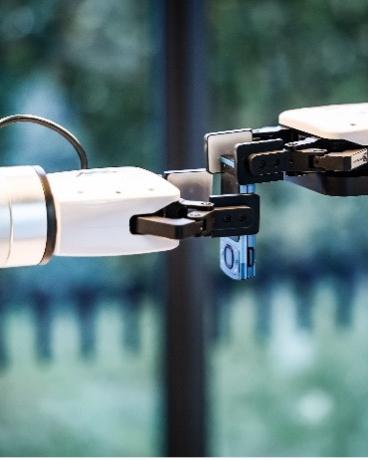
A key example is the Circular Digital Economy Lab (CDEL, funded by the state of North Rhine-Westphalia), which was created in the predecessor project Prosperkolleg. This demonstration lab is being further developed and technically expanded in the Transferhub. The system developed in the lab automatically detects, dismantles and separates small electrical appliances in order to optimize recycling processes. In CDEL 2.0, state-of-the-art mechanical, chemical and thermal processes are also used to reuse industrial waste materials and recover valuable elements such as rare earths. The new analytics laboratory also enables the rapid and precise collection of material data, creating the basis for data-based decisions.
AI-supported processes and the use of transfer learning continuously improve the application possibilities and provide new impetus for industrial symbioses. In this way, application-oriented research becomes measurable resource efficiency - and waste materials become new added value.
Well networked and practice-oriented
Whether in product design, purchasing, production or recycling - the fields of action in the circular economy are diverse. One of the Transfer Hub's main tasks is to draw the attention of SMEs and craft businesses to this and encourage them to adopt digital and recyclable processes. Parallel to the development of technical solutions, it is important to use and expand existing contacts.
Both Ruhr West University of Applied Sciences and Prosperkolleg e.V. are very well networked in the corporate landscape of the northern Ruhr region. Prosperkolleg e.V. formats such as the virtual research network #CEresearchNRW, as well as the publication series from practice, ReThink and Prospektiven bring science and business together. The Transferhub provides content-related impetus for these existing formats directly from its own laboratories and offers companies the space and platform to successfully implement circular strategies. This makes the Transferhub a driving force for a climate-neutral economy in the northern Ruhr region with an impact on the entire Ruhr region and beyond. After all, preparing for the future and becoming a model region for the digital circular economy is a joint task for the region, the state and the EU.