IustitiAI – When AI Strengthens the Rule of Law in the Digital Space
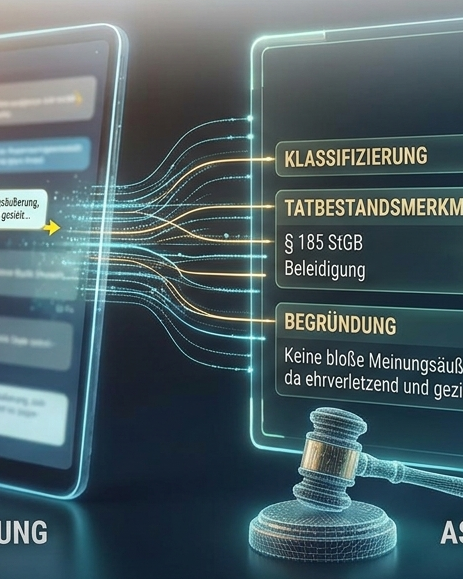
When does a provocative statement online become a criminal offense? This question is often difficult to answer. That’s because, in addition to the wording itself, context, laws, and case law play a decisive role. At the same time, the volume of digital content published daily is growing. The “iustitiAI” project is developing an AI assistant that identifies potentially criminal online content, evaluates it from a legal perspective, and provides a transparent rationale for its assessment. The goal is to combat digital hate crimes more effectively and strengthen the rule of law in the digital space.
Detecting digital legal violations more effectively
Insults, threats, identity theft, deepfakes, and copyright infringements are on the rise in the digital space. This poses a major challenge for those affected, platform operators, law enforcement agencies, and the judiciary: content relevant to criminal law must be identified, preserved, and legally assessed from an enormous volume of posts. Existing AI systems can classify some content as hate speech. In most cases, however, a legally sound justification is lacking. This is precisely where iustitiAI comes in. The system is designed not only to detect problematic content but also to explain which elements of a criminal offense are fulfilled or why a statement remains legally permissible.
AI Meets Legal Expertise
For this project, two partners are combining their strengths: SO DONE GmbH contributes its practical experience in combating digital hate crimes. The University of Wuppertal complements this knowledge with its research on artificial intelligence and the structured processing of large amounts of information. To this end, a digital knowledge base is being built in which laws, court rulings, and other specialized information are linked together. This enables the system to identify connections and better understand which legal rules apply to a given statement. Additionally, the AI specifically draws on verified and reliable sources before generating an assessment. This is intended to ensure that the results are professionally sound, clearly justified, and easier to verify.
First AI component already developed
The project launched in early 2026. Currently, the project partners are building a legal knowledge base and analyzing German datasets containing examples of hate speech. In doing so, they are investigating various knowledge graph technologies. A knowledge graph is a type of digital network of relationships: for example, it links laws, criminal offenses, individual legal characteristics, and court rulings. This enables the AI to recognize which pieces of information belong together and are important for evaluating a statement. At the same time, the first so-called RAG pipelines are being developed. In this process, the system first searches for relevant information in verified sources before the AI formulates a response or assessment. This is intended to prevent the AI from relying solely on its previously acquired knowledge or generating unsubstantiated statements. In addition, the project partners are developing suitable prompting strategies. These refer to specifically formulated tasks and questions posed to the AI. They help ensure that the system takes relevant legal aspects into account, structures its assessment in a comprehensible manner, and arrives at results that are as reliable as possible.
An initial AI classifier has already been developed. It identifies relevant criminal offenses and explains which legal criteria might be met. The system also indicates whether the elements of a criminal offense are present. In this way, iustitiAI lays the foundation for a nuanced distinction between criminal content and permissible expression of opinion.
Relief for the Judicial System and Content Moderation
In the future, iustitiAI is intended to support the judicial system, law enforcement agencies, and content moderators in handling digital legal violations. Thanks to its high detection accuracy, relevant cases could be identified and processed legally more quickly. This can alleviate the workload on legal systems and help those affected enforce their rights in a more transparent manner. The technology is scalable. In the future, it could also be applied to cyber fraud, copyright infringements, or deepfakes.
Impulses for North Rhine-Westphalia and Europe
iustitiAI is creating a GovTech solution at the intersection of science, business, and the rule of law. GovTech stands for “Government Technology” and refers to the use of digital technologies to make government tasks and public services more effective and user-friendly. The project strengthens North Rhine-Westphalia as a technology hub while also contributing to the protection of a culture of democratic debate. The development is guided by the AI Act and the Digital Services Act. The AI Act establishes uniform EU-wide rules for artificial intelligence and sets varying requirements for its use depending on the level of risk. The Digital Services Act requires online platforms to provide greater protection against illegal content, as well as greater transparency and accountability. Both sets of regulations were proposed by the European Commission and subsequently adopted by the European Parliament and the Council of the European Union.
From Knowledge Base to Practical Testing
By 2028, iustitiAI will be gradually expanded into a digital assistance suite that provides clear and comprehensible justifications for legal assessments. The focus is on building the knowledge graph, further developing the language model, and conducting practical testing. Transparency, fairness, and legal compliance are taken into account from the very beginning. Initially, the solution is intended for the German legal system; however, it is expected to be adaptable to other European languages and legal systems in the future.