HeiDi – Developing Tomorrow’s Rail Transportation with Digital Twins
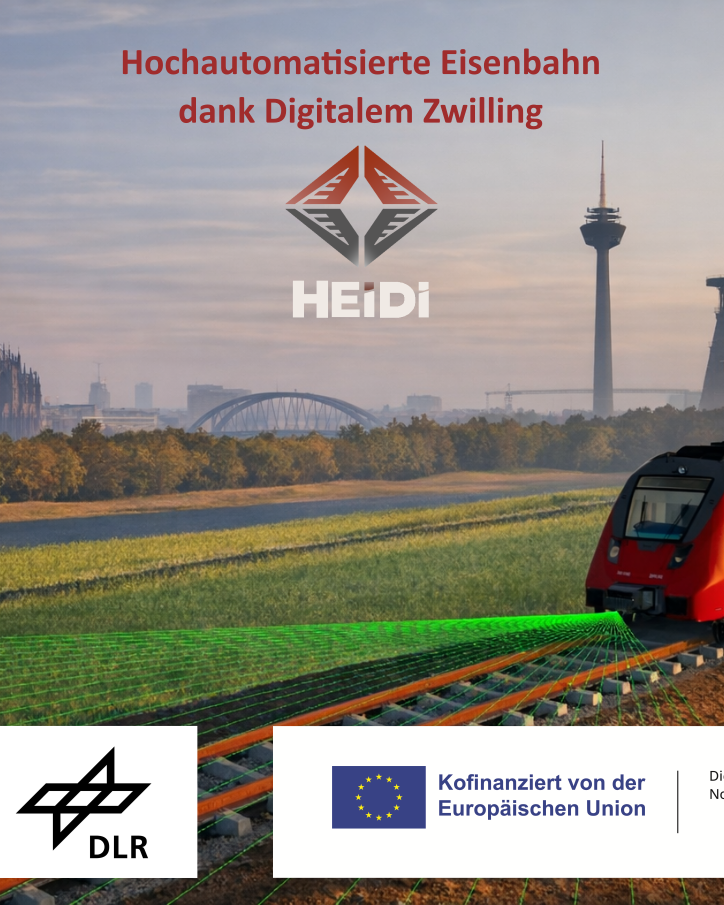
Digitalization and automation are considered key to efficient and climate-friendly rail transportation. However, before highly automated systems can be deployed on the rails, sensors and assistance systems must undergo extensive testing and validation. This is precisely where the HEiDi project comes in. IKADO GmbH and the German Aerospace Center (DLR) are jointly developing a digital twin of the Wegberg-Wildenrath Test Center in North Rhine-Westphalia. This digital twin virtually replicates the real-world test environment—including vehicle and sensor models—thereby enabling realistic simulations. The goal is to make the development and testing of sensor systems faster, more flexible, and more cost-effective.
Simulation as a Building Block for Automated Rail Systems
The project combines real-world tests with analyses in a virtual environment. This allows researchers to verify how reliably digital models represent reality and how simulations can be used in the future in the certification processes for highly automated rail systems. A particular focus is on the virtual validation of sensor technology, an approach already used in automotive research and now being applied to rail transport. In addition, a shunting assistant developed by IKADO is being integrated into the simulation environment and used as a basis for both real-world and virtual testing.
Open Platform for Innovation in Rail Freight Transport
The simulation environment developed in the project is to be released as an open-source solution. This will allow other companies and research institutions to use the results, further develop them, and adapt them for their own use cases. HEiDi is thus laying the groundwork for greater innovation in rail transportation and can help accelerate digitalization and automation in rail freight transport. At the same time, the project strengthens the competitiveness of North Rhine-Westphalia as a hub for intelligent mobility and logistics solutions.