B2B-RARE - Research for Rare Diseases
They are chronic, often genetic, rarely curable and barely researched: that's what rare diseases are all about. There are more than 8,000 of them and, according to current estimates, around four million people in Germany are affected - an above-average number of them in NRW. The B2B-Rare research project is looking into them.
Diagnosis, research and treatment under one roof
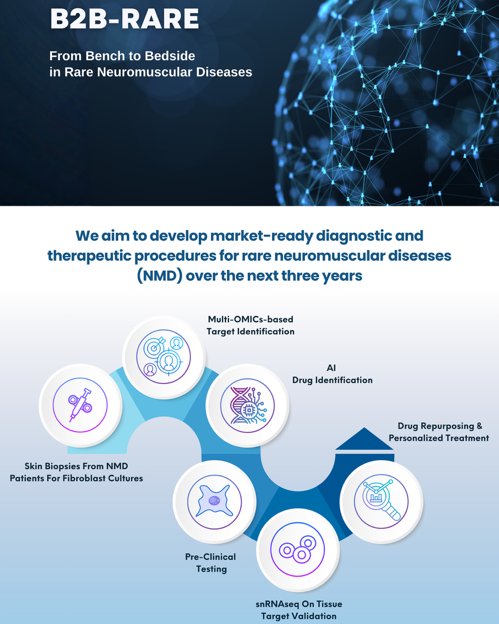
Instead of investigating individual rare diseases, the project partners from university hospitals, research and industry are pursuing a different approach: it promises rapid, minimally invasive diagnosis and personalized treatment of many different neuromuscular diseases and can be transferred to research into other diseases. The basic idea behind B2B-Rare is as simple as it is compelling: to create opportunities within a project to diagnose and at the same time research personalized treatment approaches for rare neuromuscular diseases. In other words, "from the laboratory directly to the patient's bedside" (bench-to-bedside, B2B). This can save sufferers long odysseys, ensure medical care close to home from a single source and at the same time gather new knowledge about rare diseases.
A skin sample as the key to diagnosis
The process starts with a minimally invasive biopsy: a small skin sample is taken from the patient. The living cells from this are multiplied in the laboratory and examined over several months - certain patterns can be used to identify the disease. AI and omics technologies are used for this, which can look at several levels of bodily processes simultaneously, from genes to metabolic products. It is comparable to a conductor who can hear which of the many instruments in his orchestra is out of tune.
Finding instead of reinventing: Searching for suitable active ingredients
This makes it possible to identify exactly which physical processes are out of kilter in which rare disease. AI is then used to search pharmaceutical databases for active ingredients already approved for other diseases for precisely this problem. If a hit is found, the corresponding drugs are first tested in the laboratory on the cell culture grown from the skin biopsy. If the application works in the laboratory, the medication can be used directly and individually tailored to the affected person.
New standards for research into rare diseases
B2B-Rare is the first project to combine and systematically evaluate the use of omics technologies with AI and minimally invasive skin biopsies. This approach could serve as a model for other research projects on the diagnosis and care of rare diseases across Europe in the future and make life easier for millions of affected people.

1,2 Mio. Euro
EU-Fördermittel
Project partners
Department of Neurology, BG University Hospital Bergmannsheil Bochum, Ruhr University Bochum; Department of Neurology, University Hospital Düsseldorf, Heinrich Heine University Düsseldorf; Department of Neuropediatrics, University Hospital Essen, University of Duisburg-Essen; Leibniz Institute for Analytical Sciences - ISAS - e. V., Lead Discovery Center GmbH (LDC), Singleron Biotechnologies GmbH